Separating Signal from Noise: Why Your Options Backtest Needs Two PnL Streams
At AlphaVols, our mission is to provide you with the clearest, most robust insights for options trading. Traders often begin by running backtests on strategies like iron condors, which is a fantastic first step in evaluating a trade idea. However, looking at a single, final PnL curve often tells only half the story.
To truly understand the source of your strategy’s returns and to gain confidence in replicating them, you must separate the profit generated by your volatility view (the time decay and volatility risk premium) from the profit generated by your directional exposure (Delta).
This is why the core advantage of AlphaVols is offering a simultaneous view of both Delta-Hedged PnL and Non-Delta-Hedged PnL. Let’s break down why this dual view is essential for serious volatility traders.
---
The Two Components of Your Strategy’s PnL
Any realized profit or loss from an options structure can be broadly attributed to two distinct streams:
1. The Volatility Stream (Premium Harvesting)
This is the intended source of profit for premium-selling strategies like the iron condor. It’s driven by the core dynamics of option pricing:
* Theta Decay (Time Premium): The expected, steady erosion of the option’s extrinsic value. * Implied vs. Realized Volatility: The profit gained when the market's expected volatility (IV) is higher than the actual movement (Realized Volatility).
2. The Directional Stream (Delta PnL)
This profit is generated from the underlying asset's movement relative to your position's net Delta. This stream can often be unintentionally large:
* As an option structure ages or the market moves, your overall net Delta changes dynamically (your Gamma exposure kicks in). * When you allow Delta to evolve naturally (without active hedging), the market's movement against this conditional accumulation of Delta can result in significant, often accidental, PnL. This is an outcome of market moves acting on the naturally accumulated Delta, not necessarily a pure volatility edge.
---
Why You Must Look at Delta-Hedged PnL
The Delta-Hedged PnL is a highly important analytical metric because it provides clarity on the source of your returns, whether your strategy is neutral or directional.
Crucially, examining the Delta-Hedged PnL does not mean you must implement a Delta hedging strategy in your live trading. Instead, it is a diagnostic and attribution tool. It simulates the PnL that would have been generated if you had perfectly neutralized your position's net Delta at every point in time.
$$ ext{Delta-Hedged PnL} = ext{Total PnL} - ( ext{Delta}_{ ext{net}} imes Delta ext{Underlying Price}) $$
Why Delta-Hedged PnL is Critical for Analysis:
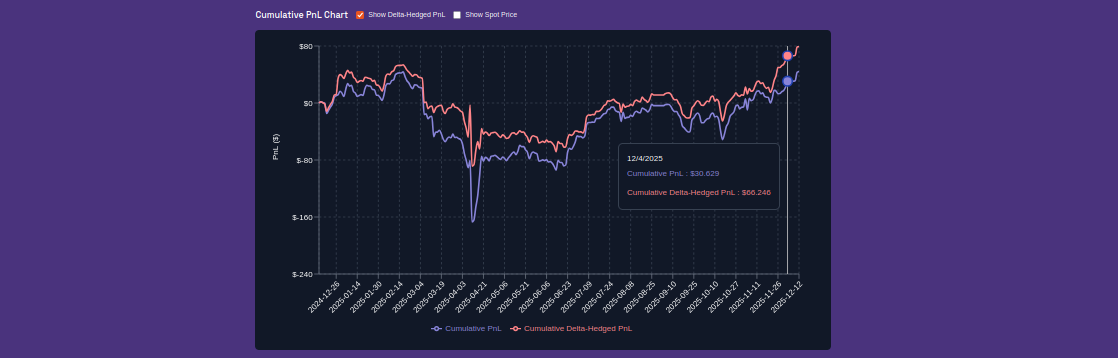
* For Neutral Strategies (e.g., Iron Condors): The primary purpose is to filter out the directional "noise." If your Non-Delta-Hedged PnL is high but your Delta-Hedged PnL is low, it strongly suggests that the volatility edge was weak and the past performance was primarily due to a favorable, but non-replicable, directional move against the accumulated net Delta. The Delta-Hedged PnL provides a more consistent guide on the pure volatility premium capture you might expect. * Visualization Insight: Notice in the graph below how the Delta-Hedged PnL for the Iron Condor is a much smoother curve, reflecting the steady capture of Theta, while the Non-Hedged PnL shows significant volatility due to market swings against the small, residual net Delta.
* For Directional Strategies (e.g., Short Puts/Covered Calls): The Delta-Hedged PnL serves to isolate your "Alpha from Volatility." Comparing your Non-Delta-Hedged PnL to your Delta-Hedged PnL shows you how much additional alpha you are generating by selling premium (the option) versus just being long the underlying stock. This distinction is key for verifying if the option structure added value beyond the simple directional move of the stock. * Visualization Insight: For the Short Put strategy below, the Non-Delta-Hedged PnL closely tracks the market's bullish moves. The Delta-Hedged PnL, however, shows the steady, positive curve of the premium collected, confirming the value added by the option structure beyond the stock's appreciation.
---
The AlphaVols Advantage: A Comprehensive View
AlphaVols eliminates the guesswork by providing both PnL streams simultaneously. You can instantly see how much of your total PnL is attributable to your deliberate volatility position (the hedged stream) and how much is from the conditional accumulation of Delta (the non-hedged stream). This comprehensive view allows you to:
* Validate your strategy: Confirm that your edge comes from the mechanism you intend (volatility premium or successful directionality). * Optimize adjustments: Understand the true impact of market movements on your core volatility exposure, informing when and how to adjust your strikes. * Build confidence: Trade knowing you fully understand why your strategy works, not just that it worked in the past.
Connecting Backtest Insight to Real-Time Action
The insights gleaned from your backtested PnL streams flow directly into your live trading decisions. Because Gamma risk ensures your net Delta is constantly changing, continuous monitoring is non-negotiable. The AlphaVols real-time risk snapshot allows you to see the precise net Delta of your strategy continuously, ensuring that the directional exposure you are carrying is always intentional. This real-time Delta visibility lets you manage risk and make adjustments that reflect the clean, profitable volatility thesis validated by your Delta-Hedged backtest.
Don't settle for half the story. Use the dual PnL view from AlphaVols to gain a professional-grade, insightful understanding of your options strategy returns.