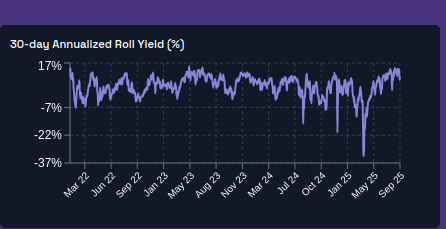
VIX Rolldown Yield: The Hidden Engine of Volatility Trading
When it comes to trading volatility, the focus is often on the direction of the VIX: is it going up or down? But for those who take a view on volatility over a period of time, there's another crucial factor to consider: VIX rolldown yield. This concept is the silent engine of returns for vol-selling positions, and understanding it is key to anticipating your profits—or losses—before the market even moves.
What is Rolldown Yield?
At its core, rolldown yield is the yield one expects to generate from a position over a period of time, assuming the underlying volatility term structure remains unchanged. It's not about the market reverting to an average, but about harvesting the time premium of volatility. This is a measure of a static yield on vol-selling positions.
The VIX market exists in one of two primary states, which directly impacts your rolldown yield:
- Contango: This is the most common state, where VIX futures prices are higher for contracts with longer maturities. The VIX curve slopes upward, as the market expects volatility to be higher in the future. This upward slope reflects a volatility risk premium 💰—investors are willing to pay a premium to protect themselves against future market turbulence. When the VIX is in contango, a short volatility position will have a positive rolldown yield, as you are selling at a high implied volatility today and will benefit as your position "rolls down" the curve toward a lower value in the future, assuming the curve doesn't change.
- Backwardation: This is a much rarer state, typically occurring during periods of market stress or panic. The VIX curve slopes downward, where near-term VIX futures are more expensive than long-term ones. The market expects volatility to be lower in the future, often because it's so high right now. In a backwardated environment, a short volatility position will have a negative rolldown yield, as you are selling at a lower implied volatility today and your position will be worth less in the future as it "rolls up" a negatively sloped curve.
Total PnL: Directional PnL + Rolldown Yield
The VIX rolldown yield is a crucial metric that helps volatility traders understand the underlying forces affecting their positions. It's not a replacement for looking at the VIX spot and futures prices, but rather a complementary piece of analysis that provides a more complete picture of potential returns.
When you enter a VIX futures position, your total profit and loss (PnL) over a specific period, say one month, is not solely determined by the change in the VIX's level. Instead, your total PnL is comprised of two distinct components:
- Directional PnL: This is the profit or loss from the change in the VIX's level over time. It's the return you get from your bet on whether volatility will rise or fall. For a short VIX futures position, a drop in the 30-day constant maturity VIX over a month would generate a positive PnL.
- Rolldown Yield: This is the profit or loss from the passage of time itself, assuming the VIX curve remains unchanged. It's a measure of the premium you're collecting (or paying) for holding a futures position.
The Direct Link to Short Volatility ETFs
This concept is the core driver behind the performance of short volatility ETFs like SVXY. These products are essentially designed to harvest the VIX risk premium. They maintain a short position by constantly selling a mix of front- and second-month VIX futures contracts. In a contango environment, they are effectively "collecting" the rolldown yield every single day. The price they get for selling the short-dated futures is higher than the price they pay to buy back and roll into the next contract.
The VIX rolldown yield is the invisible component of their return. It is the steady, positive income that they generate as long as the VIX curve remains in a normal, upward-sloping state. This yield is their compensation for taking on the risk that a market sell-off will materialize and cause the VIX to spike.
For example, the total PnL you would realize on an SVXY position is the sum of these two components. If you had bought SVXY when the 30-day CM VIX was at 20 and, over the course of a month, it fell to 18, while the average rolldown yield was 10%, your total PnL would be the sum of two factors:
- A 5% PnL from the rolldown yield, calculated as 10% (the rolldown yield) multiplied by -0.5 (SVXY's leverage).
- A 5% PnL from the directional move, calculated from the -10% drop in the CM VIX (from 20 to 18) multiplied by -0.5 (SVXY's leverage).
In this scenario, your total PnL for the month would be 10%.
Conclusion
VIX rolldown yield isn't a replacement for other metrics, but rather a crucial additional metric that puts into perspective the current shape of the VIX curve and the potential return from your long or short volatility position. It's the difference between blindly entering a trade and having a clear, data-driven expectation of a static yield.